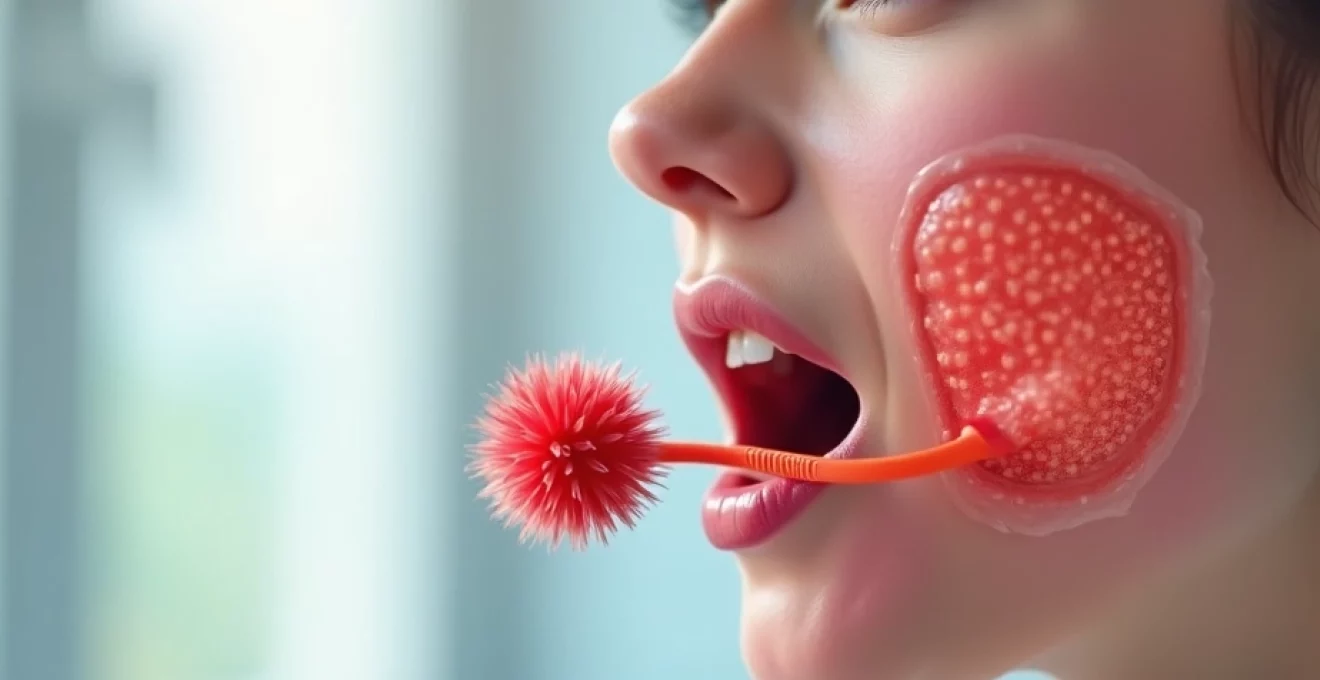
Corticosteroid inhalers represent an essential treatment modality for millions of asthma and COPD patients worldwide, yet their use frequently precipitates an uncomfortable side effect: oral thrush. This fungal infection affects approximately 15-20% of individuals using inhaled corticosteroids regularly, manifesting as distinctive white patches on the tongue, inner cheeks, and throat. The condition, medically termed oropharyngeal candidiasis, occurs when the delicate balance of microorganisms in your oral cavity becomes disrupted by the immunosuppressive effects of inhaled medications. Understanding the mechanisms behind this common complication and implementing targeted prevention strategies can significantly reduce your risk whilst maintaining optimal respiratory health through continued inhaler therapy.
Understanding oral candidiasis pathophysiology in corticosteroid inhaler users
The development of oral thrush in inhaler users involves a complex interplay between medication delivery, local immune suppression, and opportunistic fungal growth. When you use a corticosteroid inhaler, medication particles inevitably deposit throughout your upper respiratory tract, including the oral cavity, rather than travelling exclusively to the lungs where therapeutic effects are desired.
Candida albicans overgrowth mechanisms in oropharyngeal tissues
Candida albicans exists naturally within your oral microbiome under normal circumstances, comprising approximately 2-5% of the total microbial population in healthy individuals. The fungus typically remains dormant, controlled by beneficial bacteria and your immune system’s surveillance mechanisms. However, when corticosteroids accumulate in oral tissues, they create localised immunosuppression that disrupts this delicate ecological balance. The steroids inhibit inflammatory responses and reduce the activity of macrophages and neutrophils – key immune cells responsible for controlling fungal proliferation.
Research demonstrates that corticosteroid exposure alters the expression of antimicrobial peptides in oral epithelial cells, particularly defensins and lactoferrin, which normally provide the first line of defence against Candida overgrowth. This compromised local immunity allows the fungus to transition from its benign yeast form to more virulent hyphal forms, leading to tissue invasion and the characteristic white plaques associated with oral thrush.
Immunosuppressive effects of beclomethasone and budesonide on oral mucosa
Different corticosteroid formulations exhibit varying degrees of local immunosuppressive activity within the oral cavity. Beclomethasone dipropionate, one of the most commonly prescribed inhaled corticosteroids, demonstrates high topical potency and prolonged tissue residence time. Studies indicate that beclomethasone can suppress local immune function for up to 12 hours following inhalation, creating extended windows of vulnerability to fungal overgrowth.
Budesonide, whilst generally considered to have a more favourable side effect profile, still produces significant local immunosuppression when deposited in oral tissues. The medication’s high lipophilicity allows extensive tissue penetration, and its relatively long half-life in respiratory tissues means that immune suppression persists well beyond the initial dosing period. Clinical data suggests that patients using high-dose budesonide formulations experience oral thrush rates comparable to those using other potent inhaled corticosteroids.
Risk factors: MDI vs DPI delivery systems and particle deposition patterns
The type of inhaler device you use significantly influences your risk of developing oral thrush due to distinct particle deposition patterns. Metered-dose inhalers (MDIs) typically generate larger aerosol particles that tend to impact the oropharyngeal region more extensively than smaller particles produced by dry powder inhalers (DPIs). Research indicates that MDI users experience oral thrush rates of 15-25%, compared to 8-15% among DPI users when using equivalent corticosteroid doses.
Pressurised MDIs create high-velocity aerosol plumes that can exceed 100 metres per second, leading to substantial medication impaction on the back of the throat, tongue, and inner cheeks. This phenomenon, known as the “cold Freon effect,” causes patients to stop inhaling prematurely, further increasing oropharyngeal deposition. Conversely, DPIs rely on your inspiratory effort to disaggregate powder particles, typically producing finer aerosols with improved lung penetration and reduced oral deposition when used with adequate inspiratory flow rates.
Xerostomia and altered oral ph contributing to fungal proliferation
Chronic corticosteroid exposure can indirectly promote Candida growth by inducing xerostomia (dry mouth) and altering the oral chemical environment. Saliva plays a crucial role in maintaining oral health through its antimicrobial properties, buffering capacity, and mechanical cleansing action. When corticosteroids reduce salivary flow or alter saliva composition, the protective mechanisms against fungal overgrowth become compromised.
The normal oral pH ranges from 6.5 to 7.5, creating an environment that favours beneficial bacteria while inhibiting pathogenic organisms. However, reduced salivary flow and altered buffering capacity can shift the oral pH towards more acidic levels, which paradoxically favours Candida proliferation. Additionally, some inhaler formulations contain lactose or other sugars as carrier particles, providing additional nutrients that can support fungal growth when these substances remain in the oral cavity following inhalation.
Clinical recognition and differential diagnosis of Inhaler-Associated thrush
Accurate identification of oral thrush requires understanding its varied clinical presentations and distinguishing features from other oral conditions. The condition manifests differently depending on the extent of fungal involvement, your immune status, and the duration of corticosteroid exposure. Early recognition enables prompt treatment and prevents progression to more severe forms of oropharyngeal candidiasis.
Visual identification of pseudomembranous and erythematous candidiasis
Pseudomembranous candidiasis represents the classic form of oral thrush, characterised by removable white or cream-coloured plaques scattered across the oral mucosa. These plaques typically appear on the tongue, inner cheeks, palate, and sometimes extend into the throat. When you gently scrape these lesions with a tongue depressor or similar instrument, they detach easily, revealing underlying erythematous (red) tissue that may bleed slightly.
Erythematous candidiasis presents as flat, red patches without the characteristic white coating, making it more challenging to identify visually. This form commonly affects the dorsal tongue surface and palate, appearing as well-demarcated areas of erythema and atrophy. Patients with erythematous candidiasis frequently report burning sensations, altered taste perception, and discomfort when consuming acidic or spicy foods. The condition often coexists with pseudomembranous lesions, particularly in patients using high-dose inhaled corticosteroids.
Distinguishing oral thrush from leukoplakia and lichen planus
Several oral conditions can mimic the appearance of thrush, necessitating careful clinical evaluation to ensure appropriate treatment. Leukoplakia appears as white patches that cannot be rubbed off, unlike the removable plaques characteristic of thrush. These lesions typically have irregular borders and a rougher texture, often occurring in response to chronic irritation from tobacco use, ill-fitting dental appliances, or other mechanical trauma.
Oral lichen planus presents as white, lacy patterns (Wickham’s striae) typically affecting the buccal mucosa bilaterally. Unlike thrush, lichen planus lesions have a reticular appearance and are firmly adherent to the underlying tissue. The condition may also present with erosive components, creating painful ulcerations that differ significantly from the relatively asymptomatic nature of early-stage thrush. Understanding these distinguishing features helps ensure you receive appropriate treatment rather than ineffective antifungal therapy for non-fungal conditions.
Microscopic examination techniques using KOH wet mount preparations
Definitive diagnosis of oral thrush requires microscopic confirmation of fungal elements in clinical specimens. The potassium hydroxide (KOH) wet mount preparation represents the most rapid and cost-effective diagnostic technique available in clinical settings. Healthcare providers collect samples by gently scraping suspected lesions with a sterile instrument, then place the material on a microscope slide with 10-20% KOH solution.
The KOH dissolves cellular debris and background material whilst preserving fungal structures, allowing clear visualisation of Candida elements. Under microscopic examination, you can observe budding yeast cells, pseudohyphae, and true hyphae that confirm active fungal infection. The presence of pseudohyphae (elongated, constricted yeast forms) particularly indicates invasive candidiasis rather than simple colonisation. This diagnostic approach provides results within minutes, enabling immediate treatment initiation.
Culture methods on sabouraud dextrose agar for species confirmation
When microscopic examination proves inconclusive or when antifungal resistance is suspected, fungal culture on Sabouraud dextrose agar provides definitive species identification and antifungal susceptibility testing. This selective medium contains high glucose concentrations and acidic pH that favour fungal growth whilst inhibiting most bacterial species. Cultures typically require 24-48 hours for initial growth, with complete identification taking 3-5 days.
Species identification becomes particularly important when patients experience recurrent infections or poor response to standard antifungal therapy. Whilst Candida albicans remains the most common causative organism, other species including C. glabrata , C. tropicalis , and C. krusei may exhibit different antifungal susceptibility patterns. Culture-based identification enables targeted therapy selection and helps identify emerging resistance patterns that could influence treatment outcomes.
Antifungal treatment protocols for Inhaler-Related oral candidiasis
Effective treatment of inhaler-related oral thrush requires a systematic approach that addresses both the acute infection and underlying risk factors. The choice of antifungal agent depends on infection severity, patient factors, and potential drug interactions with existing respiratory medications. Topical antifungals remain the first-line treatment for uncomplicated cases, whilst systemic therapy is reserved for severe or refractory infections.
Nystatin suspension represents the most commonly prescribed topical antifungal for oral thrush, available as a ready-to-use liquid containing 100,000 units per millilitre. The standard dosing regimen involves holding 4-6 millilitres in your mouth for several minutes before swallowing, administered four times daily for 7-14 days. Proper administration technique significantly influences treatment success – you should swish the medication thoroughly throughout the oral cavity, ensuring contact with all affected areas before swallowing to address any oesophageal extension.
Clotrimazole troches provide an alternative topical approach, particularly beneficial for patients who struggle with liquid medications or require extended contact time. These slowly dissolving lozenges contain 10 milligrams of clotrimazole and should be allowed to dissolve completely in your mouth over 15-30 minutes, five times daily for 7-14 days. The extended contact time achieved with troches often provides superior therapeutic outcomes compared to liquid formulations, particularly for posterior oral cavity and throat involvement.
Systemic antifungal therapy with fluconazole becomes necessary for severe infections, immunocompromised patients, or those with poor response to topical treatments. The standard dosing regimen involves 150-200 milligrams daily for 7-14 days, though some patients may require longer treatment courses. Fluconazole offers excellent oral bioavailability and tissue penetration, achieving therapeutic concentrations in saliva and oral tissues within hours of administration. However, you should be aware of potential drug interactions, particularly with warfarin, certain cardiac medications, and some respiratory drugs.
Recent clinical guidelines emphasise the importance of continuing inhaled corticosteroid therapy during antifungal treatment, as respiratory symptom control takes precedence over oral thrush management in most cases.
Treatment duration varies based on infection severity and patient response, with most uncomplicated cases resolving within 7-10 days of appropriate therapy. However, patients using high-dose inhaled corticosteroids may require extended treatment courses or prophylactic antifungal regimens. Some specialists recommend intermittent prophylactic antifungal therapy for patients with recurrent infections, typically involving weekly fluconazole doses or periodic nystatin courses.
Preventive strategies and inhaler technique modifications
Prevention of inhaler-related oral thrush requires a multifaceted approach combining optimal inhaler technique, post-inhalation oral hygiene measures, and appropriate device selection. These strategies can reduce thrush incidence by 60-80% when implemented consistently, allowing you to maintain necessary corticosteroid therapy whilst minimising oral complications.
Spacer device selection: AeroChamber plus vs OptiChamber diamond
Spacer devices represent the most effective intervention for reducing oral deposition of inhaled corticosteroids, with studies demonstrating 50-70% reductions in oropharyngeal drug accumulation when used correctly. The AeroChamber Plus Flow-Vu features a transparent design with flow indicators that provide visual feedback on your inhalation technique. Its electrostatic-dissipative coating reduces medication adhesion to chamber walls, ensuring more consistent drug delivery to the lungs rather than oral cavity.
The OptiChamber Diamond utilises advanced valve technology and chamber geometry to optimise aerosol characteristics for improved pulmonary deposition. Its dual-valve system prevents aerosol loss during exhalation whilst maintaining optimal particle suspension during inhalation. Clinical comparisons suggest both devices achieve similar reductions in oral thrush incidence, with device selection often depending on individual preferences, breathing patterns, and coordination abilities.
Proper spacer maintenance proves equally important as device selection for maintaining protective benefits. You should wash your spacer weekly with warm, soapy water and allow air drying to prevent bacterial or fungal contamination. Replace spacer devices according to manufacturer recommendations, typically every 6-12 months, as valve function and chamber properties may deteriorate with extended use, reducing their protective effectiveness.
Post-inhalation oral hygiene protocols with chlorhexidine gluconate
Immediate oral hygiene following inhaler use provides a critical defence against corticosteroid accumulation and subsequent fungal overgrowth. Simple water rinsing removes approximately 40-50% of residual medication, whilst more comprehensive protocols can achieve 70-80% reduction in oral drug levels. The optimal approach involves gargling and rinsing with 10-15 millilitres of water immediately after each inhaler use, ensuring thorough coverage of all oral surfaces.
Chlorhexidine gluconate 0.12% provides enhanced antimicrobial protection compared to water alone, particularly for high-risk patients or those with previous thrush episodes. This antimicrobial agent demonstrates broad-spectrum activity against fungi and bacteria , helping maintain oral microbial balance despite corticosteroid exposure. Use chlorhexidine rinse 2-3 times weekly rather than daily to avoid oral microbiome disruption or taste alteration that could affect treatment compliance.
Timing of oral hygiene measures significantly impacts their effectiveness in preventing thrush development. Immediate rinsing within 2-3 minutes of inhaler use provides optimal results, as delayed intervention allows greater tissue penetration of corticosteroid particles. Some patients benefit from tooth brushing 30-60 minutes after inhaler use, though immediate brushing may actually increase tissue trauma and corticosteroid absorption in some cases.
Timing modifications between inhaler use and oral care routines
Strategic timing of inhaler administration relative to daily oral care routines can significantly influence thrush risk whilst maintaining therapeutic effectiveness. Morning inhaler use followed by breakfast and routine tooth brushing provides natural mechanical clearance of residual medication through food consumption and oral hygiene activities. This approach proves particularly effective for twice-daily dosing regimens where evening doses can be similarly timed with dinner and bedtime oral care.
For patients requiring more frequent dosing, establishing consistent intervals between inhaler use and oral care becomes crucial. Allow at least 30 minutes between corticosteroid inhalation and tooth brushing to prevent mechanical trauma that could enhance drug absorption into oral tissues. Conversely, performing thorough oral hygiene immediately before inhaler use may actually increase absorption by removing the protective mucus layer that normally impedes drug penetration.
Consider adjusting meal timing in relation to inhaler use, as eating within 15-30 minutes of inhalation provides natural oral cleansing through saliv
ary stimulation and mechanical cleansing action. Research indicates that consuming foods with varied textures and temperatures can help dislodge medication particles whilst promoting salivary flow that naturally cleanses the oral cavity.
Probiotics supplementation with lactobacillus reuteri strains
Emerging evidence suggests that specific probiotic strains can help restore oral microbial balance and reduce Candida overgrowth risk in patients using inhaled corticosteroids. Lactobacillus reuteri strains ATCC 55730 and ATCC PTA 5289 demonstrate particular efficacy in oral environments, producing antimicrobial compounds called reuterins that specifically inhibit fungal proliferation whilst preserving beneficial bacteria populations.
Clinical studies indicate that daily supplementation with these specific L. reuteri strains can reduce oral thrush incidence by 40-60% in high-risk patients using inhaled corticosteroids. The recommended dosing involves one lozenge containing at least 200 million colony-forming units dissolved slowly in the mouth once daily, preferably in the evening after completing all inhaler medications and oral hygiene routines. This timing allows maximum probiotic colonisation during the overnight period when salivary flow naturally decreases.
The protective mechanism involves competitive exclusion, where beneficial bacteria occupy ecological niches that would otherwise support Candida growth. Additionally, L. reuteri produces organic acids that help maintain optimal oral pH levels whilst stimulating local immune responses that enhance natural antifungal defences. However, you should maintain consistent supplementation for 4-6 weeks to establish stable colonisation, as interrupted use may allow rapid return of fungal overgrowth risk.
Consider combining probiotic supplementation with prebiotic foods that support beneficial bacteria growth, including yogurt with live cultures, kefir, and fermented vegetables. Avoid taking probiotics simultaneously with antifungal medications, as these treatments may reduce probiotic effectiveness. Instead, space probiotic consumption at least 2-3 hours apart from antifungal therapy to maximise both therapeutic benefits.
Long-term management and recurrence prevention in chronic asthma patients
Patients requiring chronic inhaled corticosteroid therapy face ongoing thrush risk that necessitates sustained preventive strategies and regular monitoring. Long-term management success depends on balancing respiratory symptom control with oral health maintenance, often requiring individualised approaches based on infection history, medication requirements, and patient compliance factors. The goal involves establishing sustainable routines that prevent recurrent episodes whilst avoiding treatment interruptions that could compromise asthma control.
Regular dental and medical follow-ups become essential components of long-term thrush prevention, with recommended screening intervals every 3-6 months for high-risk patients. During these visits, healthcare providers should assess oral cavity health, review inhaler technique, evaluate preventive measure compliance, and adjust treatment regimens as needed. Early detection of subclinical infections enables prompt intervention before symptomatic thrush develops, reducing treatment duration and preventing complications.
Medication optimization represents another crucial aspect of long-term management, involving periodic evaluation of corticosteroid dosing, formulation selection, and delivery device choices. Some patients may benefit from step-down therapy during periods of good asthma control, temporarily reducing corticosteroid exposure whilst maintaining adequate symptom management. Alternative medications such as leukotriene modifiers, long-acting bronchodilators, or biologic agents may enable corticosteroid dose reduction in selected patients.
Patient education and self-monitoring skills prove vital for successful long-term prevention, empowering individuals to recognise early thrush symptoms and implement appropriate interventions. Develop personalised action plans that outline specific steps to take when oral symptoms develop, including when to initiate self-treatment versus seeking professional care. Regular technique assessments ensure continued proper inhaler and spacer use, as declining technique over time can increase oral deposition and thrush risk.
Studies demonstrate that patients who maintain consistent preventive routines experience 70-80% fewer thrush episodes compared to those with irregular compliance, emphasising the importance of establishing sustainable long-term habits.
Consider seasonal adjustments to preventive strategies, as respiratory infections, environmental allergens, and medication adherence patterns may vary throughout the year. Some patients require intensified preventive measures during peak allergy seasons when higher corticosteroid doses become necessary for symptom control. Conversely, periods of stable respiratory health may allow relaxation of some preventive interventions whilst maintaining core protective measures such as spacer use and post-inhalation oral hygiene.
Finally, stay informed about emerging preventive technologies and treatment approaches that may enhance long-term management outcomes. New inhaler formulations with improved lung targeting, novel spacer designs, and advanced antifungal prophylaxis strategies continue to evolve, potentially offering better protection against oral thrush whilst maintaining optimal respiratory therapy effectiveness. Regular communication with your healthcare team ensures access to the most current and effective management approaches for your individual situation.