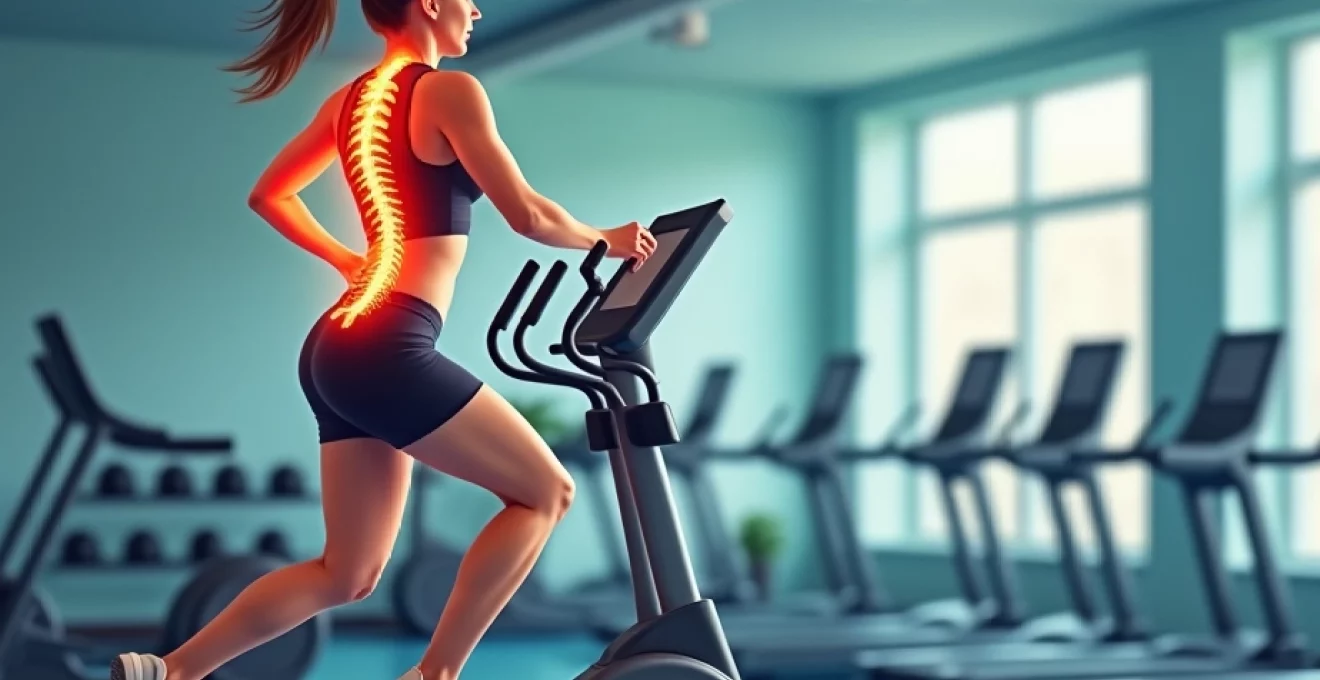
The elliptical trainer has become a staple in fitness facilities worldwide, marketed as the perfect low-impact cardiovascular solution for those seeking joint-friendly exercise. However, emerging research from institutions like the University of Waterloo suggests that this seemingly benign piece of equipment may not be as spine-friendly as previously believed. Studies indicate that up to 23% of regular elliptical users experience some form of lower back discomfort during or after their workouts, challenging the conventional wisdom about this popular exercise machine.
While the elliptical’s reputation for being gentler on the knees and ankles compared to treadmill running remains largely valid, the biomechanical demands placed on the lumbar spine tell a different story. The unique motion pattern required for elliptical training can create specific stressors that affect spinal alignment, muscle activation patterns, and joint mechanics in ways that may predispose users to back pain. Understanding these mechanisms becomes crucial for fitness enthusiasts, personal trainers, and healthcare professionals who regularly recommend or utilise elliptical training as part of rehabilitation or fitness programmes.
Biomechanical factors contributing to Elliptical-Induced lumbar spine stress
The biomechanical profile of elliptical exercise presents several unique challenges for spinal health that distinguish it from natural gait patterns. Research conducted by spine biomechanics experts has identified multiple factors that contribute to increased lumbar stress during elliptical training, with implications extending beyond immediate discomfort to potential long-term spinal health concerns.
Hip flexor tightness and anterior pelvic tilt during elliptical motion
The elliptical’s pedal trajectory necessitates a sustained hip flexion position that places the hip flexor muscles in a shortened state throughout the exercise duration. This positioning creates a cascade of biomechanical compensations that directly impact lumbar spine alignment. When hip flexors, particularly the iliopsoas complex, remain in a contracted state for extended periods, they develop adaptive shortening that pulls the lumbar vertebrae into increased lordosis.
The anterior pelvic tilt that results from tight hip flexors fundamentally alters the loading patterns across the lumbar spine. Excessive lumbar lordosis increases compression forces on the posterior elements of the vertebrae, including the facet joints and laminae, while simultaneously placing the intervertebral discs under uneven stress. This biomechanical dysfunction becomes particularly problematic when individuals with pre-existing hip flexor restrictions attempt elliptical training without adequate preparation or corrective interventions.
Thoracolumbar fascia tension from sustained forward lean posture
The typical forward-leaning posture adopted during elliptical exercise creates sustained tension in the thoracolumbar fascia, a complex network of connective tissue that plays a crucial role in spinal stability and load transfer. Unlike walking or running, where postural variations occur naturally throughout the gait cycle, elliptical training often locks users into a relatively fixed spinal position for the entire workout duration.
This sustained positioning places the thoracolumbar fascia under continuous tension, particularly in the lower lumbar region where the fascia integrates with the latissimus dorsi, gluteus maximus, and contralateral internal oblique muscles. When this fascial system becomes overloaded, it can develop trigger points and areas of restricted mobility that refer pain to the lower back. The lack of natural postural variation during elliptical exercise prevents the normal relaxation and remodelling cycles that occur during varied movement patterns.
Sacroiliac joint dysfunction from asymmetrical stride patterns
Asymmetrical movement patterns commonly develop during elliptical training due to individual anatomical variations, muscle imbalances, or improper machine setup. These asymmetries can place uneven stresses on the sacroiliac joints, which serve as the critical link between the spine and pelvis. Research indicates that even subtle asymmetries in stride length or force production can create rotational stresses that exceed the sacroiliac joint’s capacity for adaptation.
The fixed nature of elliptical pedals, unlike the ground reaction forces experienced during walking or running, prevents natural compensatory mechanisms from addressing these asymmetries. Over time, repeated asymmetrical loading can lead to sacroiliac joint dysfunction , characterised by pain, stiffness, and altered movement patterns that extend beyond the exercise session itself.
Erector spinae muscle fatigue in extended exercise sessions
The sustained isometric contraction required of the erector spinae muscles during elliptical exercise creates a unique fatigue pattern that differs significantly from dynamic activities. These muscles must maintain spinal extension against gravity while simultaneously managing the rotational forces generated by the reciprocal arm and leg movements characteristic of elliptical training.
As the erector spinae muscles fatigue during extended sessions, their ability to provide adequate spinal stabilisation diminishes, leading to compensatory recruitment of secondary stabilising muscles. This compensation pattern can result in altered movement quality and increased stress on passive spinal structures, including ligaments and joint capsules, which are less equipped to handle prolonged loading.
Machine design flaws in popular elliptical models affecting spinal alignment
The engineering and design characteristics of different elliptical models can significantly influence spinal alignment and loading patterns during exercise. Manufacturing variations in stride geometry, handle positioning, and adjustability features create distinct biomechanical environments that may predispose users to back pain. Understanding these design limitations becomes essential for making informed equipment selection decisions.
Inadequate stride length adjustment on NordicTrack commercial series
The NordicTrack Commercial series, while popular in both commercial and home settings, presents specific limitations in stride length customisation that can impact spinal alignment. The fixed 20-inch stride length may not accommodate the natural gait patterns of users across different height ranges, forcing shorter individuals into overextension patterns and taller users into cramped positioning.
When stride length doesn’t match an individual’s natural gait mechanics, compensatory movements occur throughout the kinetic chain, with the lumbar spine bearing much of the adaptive burden. Users forced to overextend may develop excessive lumbar extension , while those cramped into shorter strides often compensate with increased trunk flexion, both patterns contributing to spinal stress and potential pain development.
Fixed handle height limitations in precor EFX models
The Precor EFX series features fixed handle heights that cannot be adjusted to accommodate users of varying statures, creating significant challenges for optimal spinal positioning. Taller individuals must often lean forward excessively to reach the handles, while shorter users may find themselves pulling upward, both scenarios creating suboptimal spinal alignment patterns.
The forward lean required by taller users when handles are positioned too low increases thoracic kyphosis and can lead to compensatory lumbar hyperextension. This positioning places increased stress on the posterior spinal elements and can contribute to facet joint irritation and muscle tension patterns that manifest as lower back pain.
Pedal angle discrepancies on life fitness Cross-Trainers
Life Fitness cross-trainers, particularly older models, exhibit pedal angle variations that can create asymmetrical loading patterns affecting spinal alignment. Manufacturing tolerances and wear patterns can result in subtle differences between left and right pedal angles, forcing users to accommodate these discrepancies through compensatory movement strategies.
These pedal angle discrepancies, often as small as 2-3 degrees, can create significant asymmetrical forces that travel up the kinetic chain to the pelvis and lumbar spine. The cumulative effect of thousands of repetitions with even minor asymmetries can lead to adaptive changes in muscle activation patterns and joint positioning that contribute to back pain development.
Console positioning issues in sole fitness E35 and E55 models
The console positioning on Sole Fitness E35 and E55 models often requires users to look downward at an angle that promotes cervical flexion and compensatory thoracic kyphosis. This head-forward posture creates a cascade of postural adaptations that extend through the entire spinal column, ultimately affecting lumbar positioning and loading patterns.
The sustained neck flexion required to view workout data encourages a forward head posture that shifts the body’s centre of gravity anteriorly. To maintain balance, users often compensate with increased lumbar lordosis , creating the same problematic spinal positioning associated with anterior pelvic tilt and hip flexor tightness.
Musculoskeletal imbalances exacerbated by elliptical training
Elliptical training can amplify existing musculoskeletal imbalances rather than correcting them, particularly in individuals who lack adequate movement preparation or corrective exercise protocols. The repetitive nature of elliptical motion, while beneficial for cardiovascular conditioning, may reinforce dysfunctional movement patterns and contribute to the development of specific muscle imbalances that predispose users to back pain.
The predominant hip flexion bias inherent in elliptical exercise can exacerbate existing imbalances between hip flexors and gluteal muscles, particularly in sedentary populations who already demonstrate gluteal weakness and hip flexor tightness from prolonged sitting. This imbalance pattern, often referred to as lower crossed syndrome , creates a self-perpetuating cycle where elliptical training reinforces the very dysfunctions that contribute to back pain.
Additionally, the forward-leaning posture commonly adopted during elliptical exercise can worsen upper crossed syndrome patterns, characterised by weak deep cervical flexors and rhomboids combined with tight pectoral muscles and upper trapezius. This combination of upper and lower crossed syndrome creates a perfect storm for spinal dysfunction and pain development.
The repetitive nature of elliptical motion, while beneficial for cardiovascular health, may inadvertently reinforce existing movement dysfunctions rather than promoting balanced muscle development and optimal movement patterns.
The lack of unilateral loading during elliptical exercise also fails to address common asymmetries that exist between left and right sides of the body. Unlike walking or running, where each leg must independently support body weight and generate propulsive forces, elliptical training provides bilateral support that allows weaker sides to be compensated for by stronger sides, potentially perpetuating imbalances.
Comparative analysis of elliptical motion versus natural gait mechanics
Understanding the fundamental differences between elliptical motion patterns and natural human gait provides crucial insights into why this exercise modality may contribute to back pain development. Natural walking and running involve complex, three-dimensional movement patterns that promote spinal mobility, muscle activation variability, and adaptive responses that are largely absent during elliptical training.
Natural gait incorporates significant rotational components through the spine, pelvis, and ribcage that facilitate efficient force transfer and energy conservation. These rotational movements, occurring in the transverse plane, are essential for maintaining spinal health and preventing the development of movement restrictions. Elliptical training, by contrast, occurs primarily in the sagittal plane with minimal rotational component, potentially contributing to spinal stiffness and reduced mobility over time.
The ground reaction force patterns during natural gait also differ significantly from those experienced during elliptical training. Walking and running create impact forces that, while initially seeming detrimental, actually provide beneficial loading stimuli that promote bone density and tissue adaptation. The smooth, continuous loading of elliptical exercise lacks these beneficial impact characteristics while still maintaining sustained loading on spinal structures.
Weight-bearing asymmetries present another crucial difference between elliptical training and natural gait. During walking, each leg alternately bears the full body weight while the contralateral leg swings through the air, creating natural loading variations that promote bilateral strength development and neuromuscular adaptation. Elliptical training maintains continuous bilateral weight bearing that may fail to adequately challenge stabilising systems and could contribute to the development of movement compensations.
The absence of single-limb support phases during elliptical exercise eliminates crucial proprioceptive challenges that are essential for developing optimal balance, coordination, and spinal stability.
Foot positioning during elliptical exercise also creates unique challenges not present in natural gait. The fixed foot position on elliptical pedals prevents the natural pronation and supination movements of the foot that normally occur during walking and running. These foot movements are crucial for shock absorption and force attenuation, and their absence during elliptical training may require compensatory mechanisms higher up the kinetic chain, including at the lumbar spine.
Evidence-based prevention strategies for Elliptical-Related back pain
Implementing comprehensive prevention strategies can significantly reduce the risk of developing back pain associated with elliptical training. These strategies must address the specific biomechanical challenges identified in elliptical exercise while promoting optimal movement patterns and muscular balance. Research-based approaches focus on preparation, technique optimisation, and progressive load management.
Pre-exercise dynamic stretching protocols for hip flexors and hamstrings
Dynamic stretching protocols targeting hip flexors and hamstrings before elliptical training can significantly improve pelvic positioning and reduce compensatory lumbar movement patterns. A comprehensive dynamic warm-up should include leg swings in multiple planes, walking lunges with rotation, and hip flexor stretches with posterior pelvic tilting to prepare the hip complex for the demands of elliptical exercise.
Specific attention should be paid to the rectus femoris, which acts as both a hip flexor and knee extensor, as tightness in this muscle can significantly contribute to anterior pelvic tilt during elliptical training. Dynamic rectus femoris stretches performed in standing positions can effectively address this limitation while promoting improved neuromuscular control patterns that transfer directly to elliptical performance.
Core stabilisation exercises using McGill’s big 3 method
Professor Stuart McGill’s research on spinal stability has identified three fundamental exercises that provide optimal core stabilisation training while minimising spinal loading. The curl-up , side bridge , and bird dog exercises form the foundation of this approach, addressing the major muscle systems responsible for spinal stability in multiple planes of movement.
Implementing McGill’s Big 3 exercises as part of a pre-elliptical routine can significantly enhance spinal stability and reduce the risk of compensatory movement patterns during exercise. These exercises specifically target the deep stabilising muscles that are crucial for maintaining optimal spinal alignment during the sustained postures required for elliptical training. The progressive nature of these exercises allows for systematic development of endurance capacity in the core stabilising system.
Proper machine setup and anthropometric adjustments
Optimal machine setup requires careful attention to individual anthropometric characteristics and movement preferences. Handle height should be adjusted to allow for a neutral spine position without excessive forward lean or upward reaching. The ideal handle position typically places the hands at approximately chest height when standing upright on the pedals.
Stride length adjustments, when available, should accommodate natural gait characteristics rather than forcing adaptation to machine limitations. Users should be able to complete the elliptical motion without reaching full knee extension or excessive hip flexion at either end of the stride pattern. Proper setup also includes ensuring adequate foot placement on the pedals to maintain neutral ankle positioning throughout the movement cycle.
Progressive training load management and session duration guidelines
Progressive load management for elliptical training should consider both cardiovascular adaptation and musculoskeletal tolerance, particularly for the spinal stabilising system. Initial sessions should be limited to 10-15 minutes to allow for adaptation to the sustained postural demands, with gradual increases of 2-3 minutes per session as tolerance improves.
Resistance and incline progressions should follow similar gradual patterns, with increases implemented only after demonstrating consistent technique and absence of post-exercise discomfort. The sustained nature of elliptical exercise requires particular attention to fatigue management, as deteriorating form due to muscle fatigue can significantly increase injury risk. Session duration should be reduced if technique begins to deteriorate, regardless of cardiovascular capacity.
Incorporating movement breaks during longer elliptical sessions can help prevent the accumulation of tissue tension and maintain optimal movement quality. Brief pauses every 10-15 minutes allow for postural reset and can significantly reduce the risk of developing compensatory movement patterns that contribute to back pain development.